Negotiating with Hair Straightener Suppliers: B2B Guide
Understanding Hair Straightener BOM: Anatomy of Manufacturing Costs
Successful price negotiation with an Original Equipment Manufacturer (OEM) requires deconstructing the unit into raw component costs rather than accepting an aggregated ex-factory quote. By isolating raw material expenses from assembly overhead, buyers gain direct leverage during price reviews without risking product integrity.
- Target standard factory margins of 12% to 18% above raw component production costs.
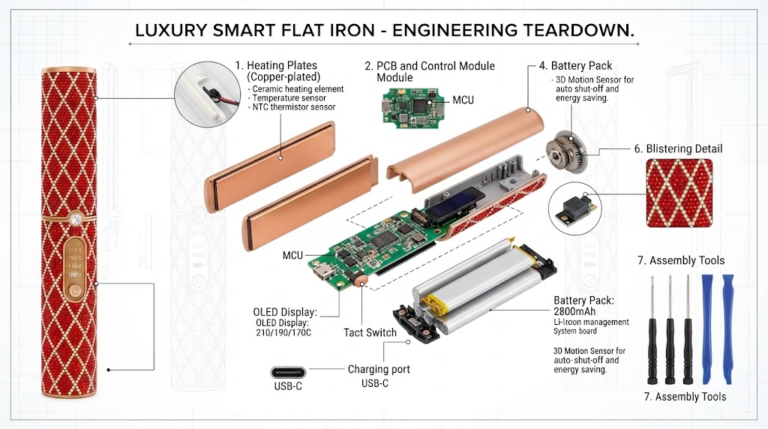
- Analyze major BOM drivers: heating elements, plate metallurgy, battery cells, and PCB microcontrollers.
- Pinpoint packaging and accessory line items to immediately shave 8% to 15% off initial landed quotes.
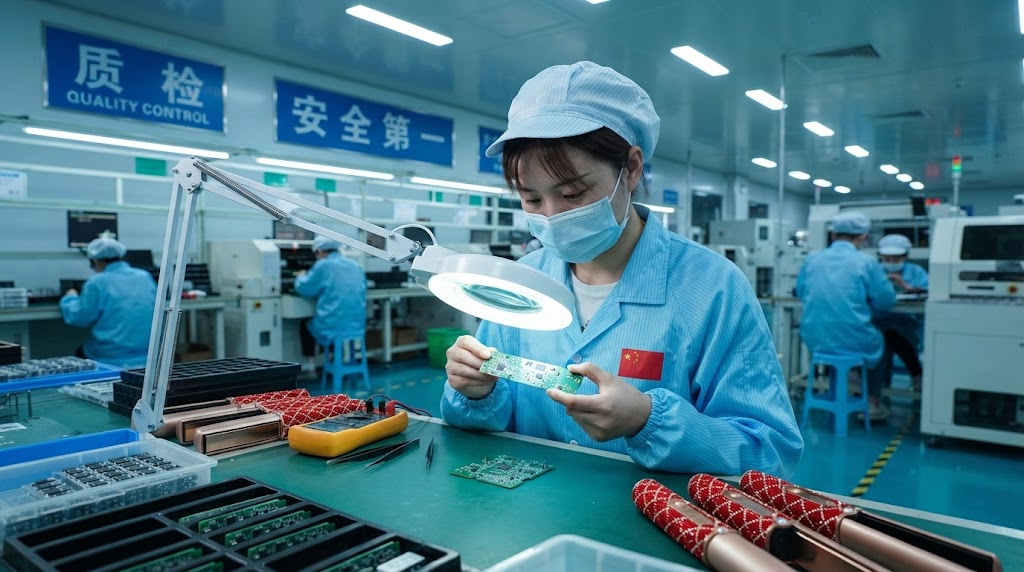
Negotiating unit economics on styling appliances requires peeling back the factory’s production markup. When sourcing through Hair Appliance Manufacturing Services, quotes are commonly inflated by 20% to 35% to account for buyer inexperience, anticipated revisions, and fluctuating raw commodity pricing.
Bill of Materials (BOM) in Appliance Manufacturing: The comprehensive inventory of raw materials, sub-assemblies, intermediate components, sub-components, and fasteners required to construct a finished thermal styling tool, including direct factory assembly labor.
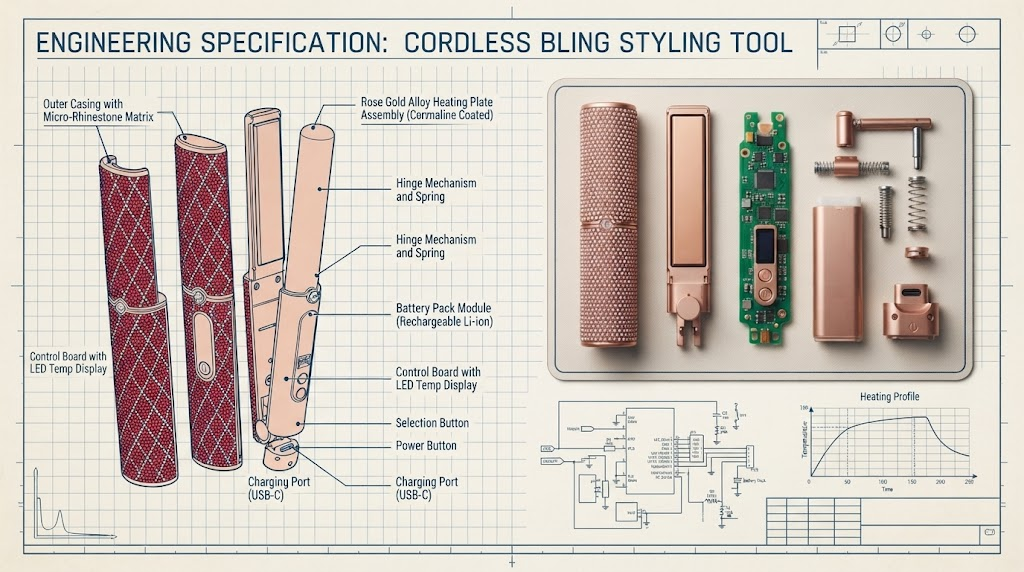
The true manufacturing cost of a professional flat iron divides into four distinct hardware categories:
- Thermal Substrate & Plates: Titanium and Ceramic Tourmaline Plates constitute the core heating interface. Cast aluminum substrates with sprayed ceramic-tourmaline coatings cost roughly 40% less than solid mirror-finish grade-5 titanium plates.
- Electronic Control & Heating Cores: The Printed Circuit Board Assembly (PCBA), Dual-NTC temperature sensors, and high-frequency microcontrollers regulate precise thermal stability. In wireless units, premium 21700 or 18650 high-discharge lithium-ion cells represent up to 30% of total BOM cost.
- Structural Enclosure: High-impact, heat-resistant polymers (such as Polycarbonate/PBT blends) prevent external chassis deformation at operating temperatures exceeding 200°C (392°F).
- Cords & Ancillary Hardware: For corded models, 360-degree salon-length (2.7m to 3.0m) swivel cords with industrial flex testing ratings represent a fixed expense often padded by factory brokers.
When you deconstruct factory quotes into these modular elements, negotiating with hair straightener suppliers shifts from blunt haggling to collaborative value engineering.
The APEX Sourcing Protocol: 4-Stage Supplier Negotiation Framework
Procurement teams need a repeatable framework to secure favorable commercial agreements. We developed the APEX Sourcing Protocol to systematically lower unit prices while safeguarding build quality across international supply chains.
1. Audit (Pre-Negotiation Verification)
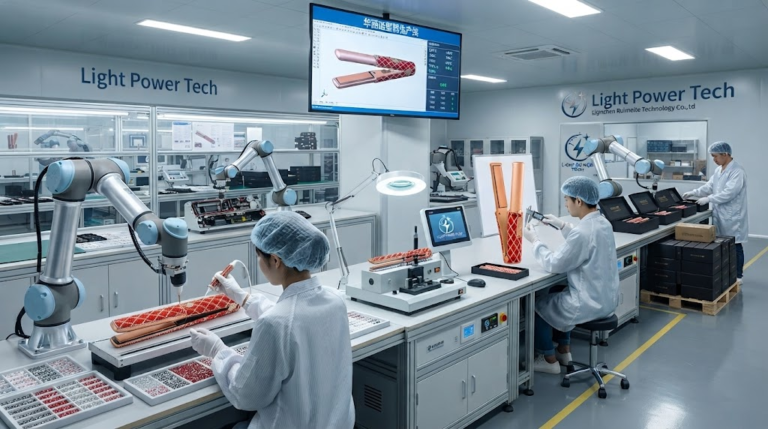
Before requesting price concessions, verify factory infrastructure. Filter out trading intermediaries on Alibaba/Global Sources B2B Platforms by validating business licenses, export documentation, and ISO 9001 quality management certifications. Real factories own their plastic injection molds and assembly cleanrooms.
2. Price-Deconstruction
Demand that all vendor bids use an open-book BOM format under standardized Incoterms (FOB, EXW, CIF). By auditing quotes on a FOB (Free On Board) basis, you isolate domestic factory transport, export packaging, and terminal handling charges from the unit’s base price.
3. Engineering-Leverage
Consult our comprehensive OEM/ODM Sourcing Guide to evaluate mechanical and electrical trade-offs. You can achieve significant unit cost reduction by substituting high-tolerance CNC-milled aluminum plates with precision die-cast substrates without altering end-user thermal performance.
4. Contract-Execution
Bind agreed pricing structures to production milestone schedules. Incorporate strict penalty clauses for unauthorized raw material substitutions, delayed batch runs, and failed third-party factory inspections.
Core Engineering Comparison: MCH vs. PTC Heating Elements
Heating elements are the functional core of any thermal styling device. Choosing between Metal Ceramic Heaters (MCH) and Positive Temperature Coefficient (PTC) stones directly impacts both your factory cost floor and consumer satisfaction.
| Specification Parameter | Metal Ceramic Heater (MCH) | PTC Ceramic Stone |
|---|---|---|
| Heat-Up Speed (to 200°C) | 15 – 30 seconds | 60 – 120 seconds |
| Thermal Recovery Rate | Instantaneous (< 2 seconds post-pass) | Slow (8 – 15 seconds post-pass) |
| Baseline Component Cost | $1.80 – $3.20 per module | $0.60 – $1.10 per module |
| Lifespan & Reliability | 5,000+ operational hours | 1,500 – 2,500 operational hours |
| Target Market Positioning | Professional salon grade / High-end retail | Budget retail / Promotional mass-market |
When negotiating price with suppliers, make sure your bill of materials matches your performance targets. Factories often suggest PTC elements to lower initial quotes, but professional-tier styling tools require MCH technology to maintain constant plate temperatures during continuous hair passes.
Tactical Cost-Cutting: Tooling Amortization, Bundling, and MOQ Strategies
Demanding a lower minimum order quantity (MOQ) while expecting top-tier volume pricing is a common mistake for emerging beauty brands. Suppliers set production minimums based on minimum raw material batch sizes and machine setup times.
The Shared Chassis Strategy
Custom plastic injection tooling for an ergonomic straightener chassis costs between $15,000 and $45,000. To minimize capital expenditures during initial production, license an established open-mold chassis from the factory.
Negotiate aesthetic exclusivity across your regional territory by customizing exterior features:
- Apply soft-touch matte PU coatings or specialized UV metallic spray finishes.
- Integrate custom silk-screened or laser-etched brand logos.
- Use bespoke silicone plate surrounds or customized LED display interfaces.
Tooling Amortization Agreements
If your product requires custom internal engineering—such as specialized thermal chambers for cordless tools—negotiate mold amortization. Rather than paying 100% of tooling fees upfront, agree to pay 50% upfront, with the remaining 50% amortized across your first 20,000 production units ($1.00 per unit rebate).
Unbundling Packaging Production
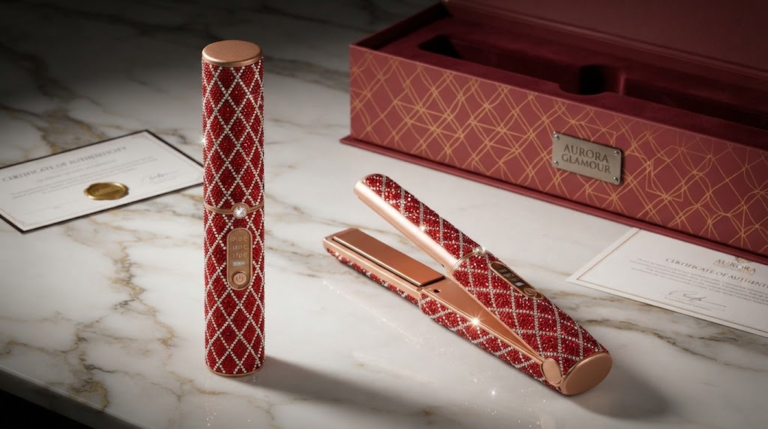
Appliance assembly plants regularly place high markups on luxury magnetic gift boxes. Negotiate an “appliance-only” ex-factory price, then source specialized rigid boxes directly from dedicated packaging converters. Have the packaging delivered straight to the straightener factory floor for final packing.
Quality Fade Defense: Golden Samples, FOC Spare Parts, and Milestone Contracts
Suppliers under pressure to lower pricing may quietly cut internal corners. This practice, known as quality fade, often involves substituting cheaper heating elements, shortening silicone wire gauges, or omitting flame-retardant casing additives.
Quality Fade: The gradual degradation of product quality over successive manufacturing cycles, as factories substitute inferior sub-components to expand their profit margins under fixed-price contracts.
The Golden Sample Protocol
Never sign a manufacturing contract without securing three identical, fully operational pre-production units signed by both the factory’s chief engineer and your sourcing lead:
- Unit 1: Held by your internal engineering and quality assurance team.
- Unit 2: Sealed and stored at the factory manager’s office as the visual manufacturing standard.
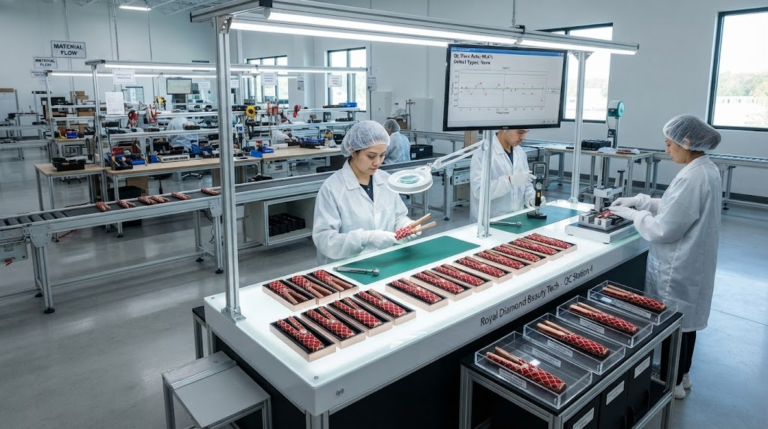
- Unit 3: Handed to an accredited third-party quality control agency to guide on-site container inspections.
Securing Free-of-Charge (FOC) Spare Parts
During contract reviews, negotiate an automatic inclusion of 1% to 2% Free-of-Charge (FOC) finished units or critical sub-assemblies (such as extra PCBAs, heating plates, and thermal fuses) with every bulk container shipment. This provides immediate replacement inventory for customer returns without requiring warranty claims against overseas manufacturers.
Milestone-Based Payment Terms
Avoid standard 30% deposit / 70% bill-of-lading terms on early production runs. Instead, link payment release directly to successful pass rates on our Factory Quality Control Checklists using ISO 2859-1 (AQL) standards:
- 30% Down Payment: Initiates raw material sourcing and tooling setups.
- 40% Post-Assembly: Released only after successful inline burn-in and dielectric withstand testing.
- 30% Final Balance: Transferred after passing a pre-shipment quality control inspection with an AQL defect limit of 0 Major / 1.0 Minor defects.
Navigating International Compliance: UL 859, ETL, CE, and Liability Terms
Selling salon tools across North American and European markets requires full electrical safety compliance. Importing uncertified thermal tools exposes your business to catastrophic product liability and border seizures.
Review requirements in our Electrical Safety Compliance Center before drafting purchase contracts.
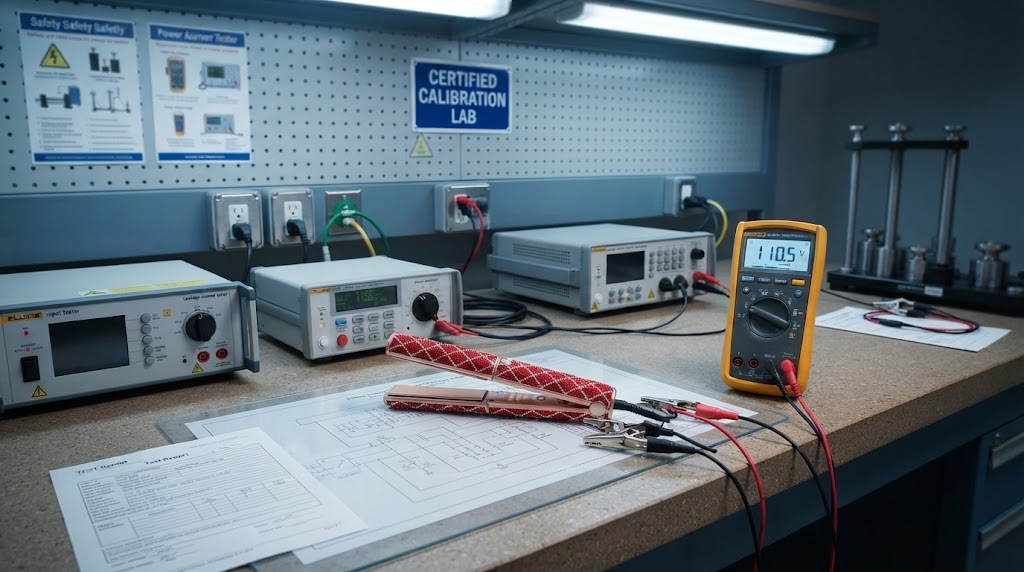
Address testing costs and liabilities directly during supplier negotiations:
- Certification Subsidies: Commercial lab testing for UL 859 (Household Electric Personal Grooming Appliances) or ETL listing ranges from $6,000 to $12,000. Negotiate a 50/50 split on initial lab costs, with the factory reimbursing your share as a credit against future production runs once volume hits 10,000 units.
- Certificate Ownership: Ensure test reports and certificates list your corporate entity as the primary license holder, rather than remaining under factory ownership.
- Product Liability Indemnification: Require the manufacturer to carry comprehensive commercial product liability insurance that names your brand as an additional insured for electrical failure or fire risks.
Industry Benchmark Data: 2026 Production Costs and Defect Tolerances
Current manufacturing benchmarks provide clear targets for negotiating terms and component pricing across major consumer electronics production hubs.
- Average Salon-Grade Landed Cost: $11.50 – $18.50 USD per unit (corded MCH units, FOB Shenzhen/Ningbo basis, 3,000-unit runs).
- High-Performance Cordless Units: $24.00 – $38.00 USD per unit (integrating high-discharge battery packs, rapid 20-second heat-up circuits, and custom thermal insulation).
- Factory Margin Averages: 14% to 18% on initial OEM private label programs; 8% to 12% on mature ODM high-volume repeat runs.
- Defect Rate Thresholds: Acceptable Quality Limit (AQL) Critical: 0.0%, Major: 1.0%, Minor: 2.5%. High-tier professional salon brands aim for a cumulative field return rate under 0.6%.
- Standard Lead Time Benchmarks: 45 to 60 calendar days for initial tooling and batch runs; 30 to 35 calendar days for repeat orders.
Copy-Paste RFQ and Counter-Offer Negotiation Scripts
Use these practical email scripts to negotiate pricing, lower order minimums, and address initial sample costs professionally.
1. RFQ Itemized Cost Breakdown Request
Subject: RFQ: Professional Salon Hair Straightener Program - [Your Brand Name]

Dear [Supplier Sourcing Manager],

Our product development team is evaluating manufacturing partners for our upcoming professional thermal styling line. We are reviewing your model [Model Number] for an initial run of [Volume, e.g., 3,000 units] under FOB terms.

To ensure proper evaluation by our procurement committee, please provide an itemized quote detailing:
1. Heating Substrate & Element (MCH specifications, plate coating thickness)
2. PCBA & Microcontroller specifications
3. Enclosure Resin grade and flame-retardant rating (UL94 V-0 standard)
4. Packaging allocation (separated from ex-factory base unit cost)
5. Current safety certifications held for US/EU markets (UL, ETL, CE, RoHS)

We conduct pre-shipment inspections via third-party auditors to AQL 0/1.0/2.5 standards. Please confirm standard production lead times and sample availability.

Best regards,
[Your Name]
Director of Supply Chain & Sourcing
[Your Brand Name]
2. Counter-Offer for MOQ Reduction Without Price Penalties
Subject: Counter-Proposal: Model [Model Number] Initial Order Terms - [Your Brand Name]

Dear [Supplier Sourcing Manager],

Thank you for your quotation. We appreciate your technical capabilities and want to build a long-term manufacturing partnership.

Our market launch roadmap requires an initial production run of 1,000 units per SKU across two colorways (2,000 units total), rather than your standard 3,000-unit single-SKU MOQ.

To help align with your production schedule and prevent machine down-time, we propose:
1. Standardizing identical internal MCH heating assemblies and PCB controllers across both SKUs.
2. Sourcing raw resin casings in a single batch, splitting only final exterior finish applications.
3. Placing a 100% deposit on packaging materials for the entire 5,000-unit annual projection, holding excess packaging at your facility for rapid turnaround on our second batch.

Please update the commercial invoice to reflect the $ [Target Unit Price] FOB rate based on this joint manufacturing schedule.

Sincerely,
[Your Name]
[Your Brand Name]
Frequently Asked Questions
How do I negotiate sample cost reimbursement with a new supplier?
Factory sample charges for customized styling tools often run 2x to 3x the standard unit cost. Insist that sample fees, tooling preparation, and domestic courier costs serve as a direct deposit, fully creditable against your first mass production purchase order.
What are standard payment terms when negotiating with overseas suppliers?
Standard starting terms are 30% T/T deposit and 70% balance paid upon bill-of-lading (B/L) presentation post-inspection. After establishing a clean track record across two consecutive order cycles, negotiate progressive terms such as Net 30 or Net 60 open account financing to preserve working capital.
How can I tell if a supplier is a real factory or a trading company?
Request an unscheduled live video tour of the main plastic injection workshop and SMT surface-mount lines. Real manufacturers can readily show their tooling inventory, cleanroom assembly lines, and high-voltage testing stations. Trading companies will often stall, decline, or provide generic promotional clips.
How do I protect my brand if a factory claims raw material prices increased?
Include an index-linked pricing clause in your master supply agreement. This limits price adjustments to verified global commodity swings (such as London Metal Exchange indexes for aluminum and copper) exceeding 8%, and requires a mandatory 60-day notice period before any new rates take effect.
Upgrade Your Thermal Styling Line with Light Power Tech
Looking for high-performance cordless engineering, patented rapid MCH heating cores, and verified factory pricing? Partner with an established manufacturer trusted across 40+ global markets.