Hair Tool Manufacturing R&D Patents: The OEM Guide
Strategic R&D Patents in Modern Hair Tool Manufacturing
Modern hair styling tools are no longer simple resistive heaters wired to basic mechanical switches. They have evolved into high-performance electro-mechanical devices that integrate high-speed digital motors, microprocessors, and sophisticated sensor arrays. In this dense competitive landscape, hair tool manufacturing R&D patents serve as the operational dividing line between high-margin market leaders and vulnerable commodity brands.
Personal care hardware operates within aggressive patent thickets. Market incumbents such as Dyson Ltd, Conair, and SharkNinja guard market share by patenting minute variations in airflow geometry, magnetic coupling, and thermal sensor polling rates. Sourcing off-the-shelf white-label platforms leaves brands vulnerable to crosshairs of patent infringement claims, border impoundments by customs authorities, and swift removal from tier-one e-commerce channels.
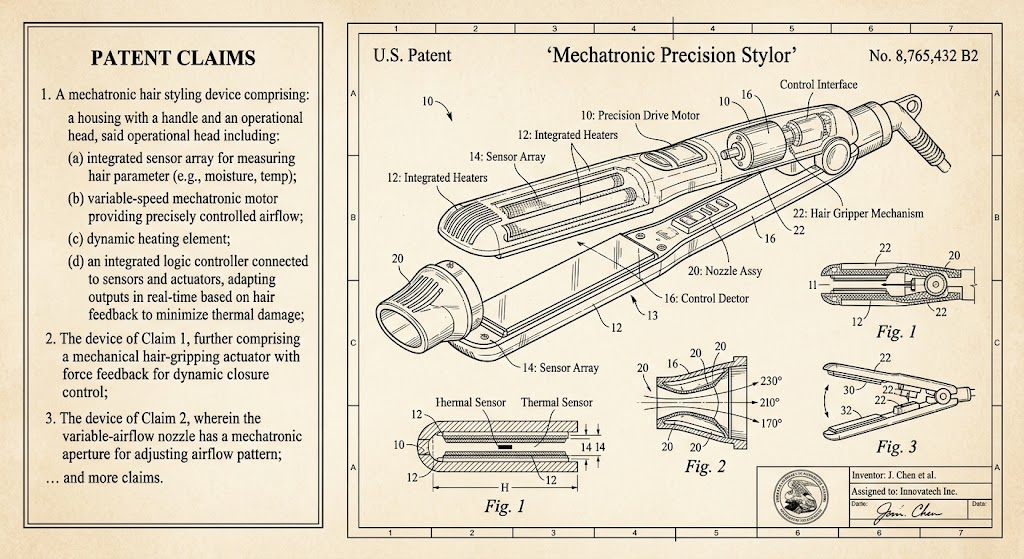
Working alongside an engineering-centric Original Equipment Manufacturer (OEM) ensures that functional innovation is paired directly with verifiable legal clearance. At Light Power Tech, our focus on cordless styling hardware and advanced heating architectures has yielded 21 global patents since our inception in 2019. Backing product development with defensible intellectual property provides hardware brands with a clear path forward, shielding products from copycats and aggressive competitor litigation alike.
Decoding Appliance IP: Utility Patents vs. Design Patents
Navigating global intellectual property offices—including the United States Patent and Trademark Office (USPTO), the European Patent Office (EPO), and the China National Intellectual Property Administration (CNIPA)—requires understanding the functional differences between utility patents vs design patents. Both forms of protection serve distinct, complementary roles in protecting hardware investments.
Utility Patent: Protects the underlying technical operation, functional mechanics, structural assembly, or electrical circuitry of a machine or process (35 U.S.C. § 101).
Design Patent: Protects the ornamental, non-functional aesthetic appearance and visual surface contours of an article of manufacture (35 U.S.C. § 171).
In hair styling tools, design patents govern external handle shapes, control switch arrangements, and barrel outlines. However, a competitor can bypass a design patent with minor adjustments to chassis bevels or radii. Conversely, utility patents protect the underlying mechanical and electrical breakthroughs, such as:
- Fluid pathways directing high-velocity air streams around an internal motor housing.
- Feedback algorithms executing real-time thermal regulation engineering via negative temperature coefficient (NTC) thermistors.
- Heat barrier configurations, such as our patented external heat-isolation sleeve that maintains comfortable exterior handling during 200°C styling cycles.
- Modular mechanical interfaces, such as secure quick-release latches or magnetic rotational interlocks.
While an aesthetic design registration provides temporary visual protection, utility patents establish lasting commercial moats. They defend the core engineering that drives product performance, reliability, and consumer demand.
The 4-Pillar Hair Tool Patent & R&D Audit Matrix
To evaluate whether a styling tool design can withstand international IP scrutiny while delivering sustained professional performance, hardware teams use our objective evaluation framework:
The 4-Pillar Hair Tool Patent & R&D Audit Matrix establishes the industry benchmark for commercializing mechatronic styling appliances. It evaluates four foundational dimensions:
- Pillar 1: Aero-Acoustic Bypass Architecture: Validating that duct configurations and impeller blade geometry achieve targets (such as >18 m/s airflow) without infringing existing fluid-adhesion patents.
- Pillar 2: Micro-Thermal Gradient Uniformity: Confirming heater surfaces maintain a narrow tolerance band (±2.5°C across working plates) governed by closed-loop microcontrollers to prevent localized hair singeing.
- Pillar 3: Co-Development IP Sovereignty: Ensuring contracts grant the brand clear, unencumbered ownership over custom tooling, cosmetic exteriors, and unique firmware.
- Pillar 4: Multi-Jurisdictional Regulatory Harmonization: Designing assemblies to meet overlapping safety mandates, including UL 859, IEC 60335-2-23, and UN38.3 transport standards for lithium systems.
Every platform engineered by Light Power Tech undergoes this validation. Whether engineering our 20-second rapid heat-up assemblies or optimizing 45-minute battery runtimes under continuous load, technical parameters must withstand rigorous patent searches and strict physical quality thresholds.
Navigating Freedom-to-Operate (FTO) in Saturated IP Landscapes
A comprehensive Freedom to Operate analysis is an essential engineering risk-mitigation step before committing capital to production tooling. An FTO search identifies live utility and design patents within target sales territories to ensure your product can be manufactured, sold, and imported without infringing third-party rights.
The FTO clearance methodology breaks down into a structured four-stage evaluation:
- Classification Index Searching: Cross-referencing relevant CPC and IPC patent classifications—specifically A45D 1/00 through A45D 20/50—across databases at the USPTO, EPO, and CNIPA.
- Claim Limitation Mapping: Dissecting competitor claims into independent limitations using formal claim charts. If a commercial design omits even one element of an independent patent claim, it typically clears that claim under the All-Elements Rule.
- Prosecution History Estoppel Verification: Auditing file histories (file wrappers) to uncover limitations or disclaimers made by the patentee during examination, which limits their broad assertion under the Doctrine of Equivalents.
- Engineering Workarounds: If an active, unavoidable claim is identified, engineering teams adjust internal duct geometry, reposition sensors, or redesign circuit traces to eliminate the overlapping limitation.
Skilled OEM ODM contract manufacturing teams coordinate patent clearance alongside computer-aided engineering (CAE) workflows. This parallel track prevents late-stage mechanical overhauls, saving months of tooling delays and thousands in legal costs.
Core Engineering Breakthroughs: Motors, Thermal Loops, and Acoustics
Meaningful innovation in personal care appliances emerges from advanced mechanical, thermal, and electrical integration. Modern engineering focuses heavily on three complex subsystems:
Brushless DC Motor Innovation
Replacing traditional brushed AC motors with compact, high-speed High-Speed BLDC Motor Engineering running at 110,000 RPM transforms airflow dynamics. High-speed three-phase sensorless motors yield air pressures exceeding 4.5 kPa. This enables rapid evaporative drying with lower thermal stress on hair fibers. BLDC motor innovation focuses on winding layouts, dynamic rotor balancing down to ≤0.5 mg, and proprietary Field Oriented Control (FOC) motor drive firmware.
Closed-Loop Thermal Engineering
Traditional bimetallic strips and basic thermistors exhibit severe thermal latency, causing temperature spikes up to 35°C past target setpoints. Modern appliances integrate glass-bead NTC sensors paired with high-frequency microcontrollers. Sampling thermal variations 50 times per second enables real-time PWM (Pulse Width Modulation) power delivery adjustments, holding heating profiles within ±2.5°C of set targets.
Acoustic Attenuation & Helmholtz Cancellation
High-velocity impellers generate prominent high-frequency tonal whine in the 2–5 kHz range. Acoustic engineering integrates tuned Helmholtz resonance cavities within the inner chassis handle walls. These channels reflect sound waves out of phase, lowering perceptible operating noise below 72 dB(A) without throttling volumetric flow.
Engineering Workarounds: Bypassing Dominant Tier-1 Airflow Moats
When market leaders commercialize innovative designs, they aggressively ring-fence their designs with patent claims. A notable example is Dyson’s use of the Coanda effect for self-wrapping hair stylers, protected by dense utility claims directed at convex curved airflow surfaces.
To deliver automated hair styling without infringing these utility patents, appliance engineering teams develop distinct fluid dynamic mechanisms. Rather than relying on continuous surface adhesion along a single exterior curve, our development team designs dual-vortex angled shear slots directly into the cylindrical barrel geometry.
These engineered micro-apertures project low-pressure vortex zones outward into the boundary layer. Hair wraps smoothly around the barrel through air vortex differentials rather than adhering to curved surfaces. This approach delivers identical styling performance while maintaining a thoroughly distinct, non-infringing mechanical execution.
Technical Trade-Off Matrix: Heating and Motor Architecture Comparisons
Selecting the core component architecture requires balancing manufacturing CAPEX against operating reliability, thermal response, and acoustic parameters. The table below illustrates critical engineering trade-offs:
| Component Subsystem | Technology Architecture | Thermal Response / Velocity | Acoustic dB(A) | Tooling / BOM CAPEX | Field RMA Rate (%) |
|---|---|---|---|---|---|
| Heating Assembly | Positive Temp. Coefficient (PTC) | Moderate (60s to 200°C) | N/A (Silent) | Low Baseline | 1.8% – 2.4% |
| Metal Ceramic Heater (MCH) | Ultra-Fast (20s to 200°C) | N/A (Silent) | Moderate (+30%) | 0.3% – 0.5% | |
| Infrared Polyimide Thick-Film | Targeted (40s to 200°C) | N/A (Silent) | High (+65%) | 0.8% – 1.1% | |
| Motor Driver | Traditional AC Commutated | Low Velocity (12–14 m/s) | 82–88 dB(A) | Low Baseline | 3.2% – 4.5% |
| Standard 12V Brushed DC | Moderate (15–18 m/s) | 76–80 dB(A) | Moderate (+20%) | 2.1% – 2.9% | |
| 110k RPM 3-Phase BLDC | High Velocity (28–35 m/s) | 68–72 dB(A) | High (+110%) | 0.2% – 0.4% |
Empirical Thermal Stress and Shell Temperature Testing
Maintaining safe exterior surface temperatures on high-output styling tools is a core engineering challenge. During salon operations, continuous heating cycles can cause excessive heat migration into the outer grip shell, risking ergonomic discomfort or burns.
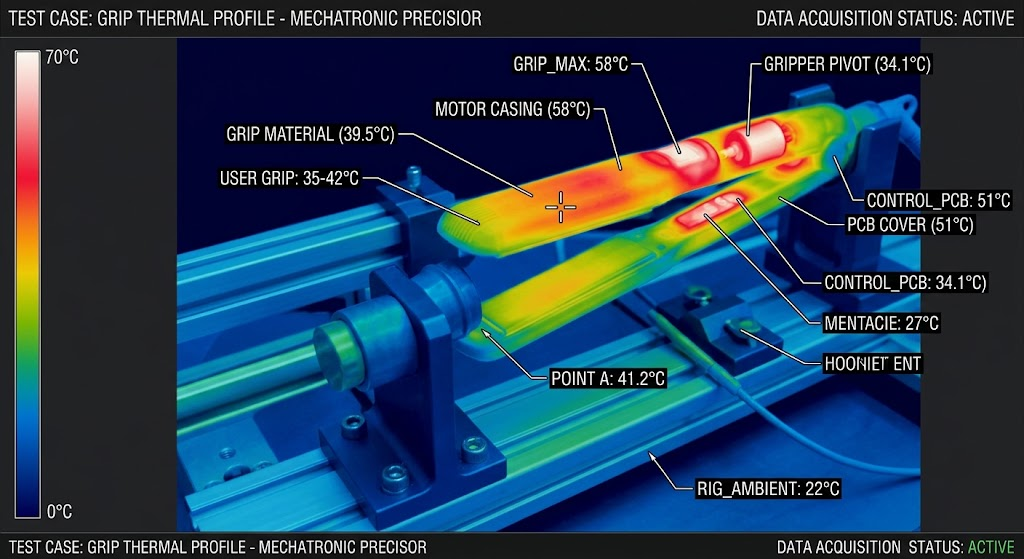
Our engineering laboratory conducted an 8-hour continuous stress test comparing standard single-wall polymer handle housings against our patented dual-chamber thermal air-jacket chassis. Testing was benchmarked under continuous 110,000 RPM operation at a 200°C output profile:
- Single-Wall Baseline Housing: Outer chassis shell temperatures elevated steadily, reaching 64.8°C at minute 45, and stabilizing at an uncomfortable 71.2°C by hour 3.
- Patented Dual-Chamber Design: Continuous internal cross-flow air diversion limited heat transfer to the exterior. Outer chassis surface temperatures stabilized at 41.6°C, never exceeding 43.5°C throughout the full 8-hour stress test.
This thermal barrier performance is validated by certified independent laboratory logs from SGS and TÜV Rheinland. These tests prove that proprietary internal channel engineering maintains handle touch-points well below maximum touch limits, ensuring regulatory safety and user comfort.
Safeguarding Proprietary IP in Contract Manufacturing & ODM Agreements
Transferring intellectual property overseas for assembly carries operational risk if contracts lack precision. When engaging an offshore manufacturing partner, your contract must clearly distinguish between Background and Foreground IP to prevent intellectual property leakage.
A legally sound OEM/ODM Co-Development Protocols agreement must clearly structure these key provisions:
- Background IP: Technical architectures, base firmware, and pre-existing utility patents owned by the contract manufacturer prior to the engagement remain the manufacturer’s property, with an irrevocable, royalty-free, worldwide production license granted to the client brand.
- Foreground IP: All bespoke industrial design elements, customized casing contours, unique UI/UX logic, and client-funded custom circuitry developed during the project must be contractually assigned as the client’s sole, exclusive property.
- Physical Tooling Ownership: Injection mold tooling, die-cast blocks, and automated assembly jigs paid for by the brand must remain the client’s exclusive physical assets. The agreement must explicitly provide the right to audit, inspect, and relocate tooling with 14 business days’ notice without financial penalty. Review our approach to Custom Tooling and Injection Molding for how this operates in practice.
- Non-Circumvention Covenants: Prohibit the factory from supplying identical structural designs, customized casings, or overstocked client runs to third-party distributors or cross-border e-commerce storefronts.
Commercial ROI: Proprietary R&D vs. Off-The-Shelf White-Label Sourcing
While off-the-shelf white-label platforms appear cost-effective initially due to near-zero upfront tooling costs, their long-term economic model is vulnerable to commoditization. The following analysis illustrates the 3-year Total Cost of Ownership (TCO) between generic sourcing and proprietary patent-backed R&D:
- Gross Margin Defensibility: Generic tools face immediate margin erosion as competitors source identical housings from open directories. In contrast, patented hardware locks in unique performance benefits, sustaining gross margins above 60% over multi-year life cycles.
- RMA & Warranty Liabilities: White-label tools frequently experience return merchandise authorization (RMA) rates between 3% and 6% from thermal stress failures. Custom-engineered platforms utilizing MCH heaters and balanced BLDC motors maintain RMA rates below 0.5%, avoiding costly reverse logistics and brand damage.
- Enterprise Valuation: When consumer brands pursue strategic exits or equity financing, holding defensible, registered utility and design patents yields substantial enterprise valuation premiums over trading businesses that merely re-badge stock inventory.
Global Electrical & Safety Compliance Verification
Securing utility patents and engineering cutting-edge thermal loops is only half the battle. Styling appliances must also clear rigorous international electrical testing before entering retail circulation. High-performance styling tools must align with Global Appliance Compliance & Certifications across all key sales regions:
- North America (UL 859 / CSA C22.2): Requires redundant thermal cutoff protection, immersion protection (ALCI plugs), and strict drop-test survivability without exposing live internal conductors.
- European Union (IEC / EN 60335-2-23 & CE LVD): Focuses on personal safety during heating element failure, electrical insulation under high humidity, and comprehensive EMC electromagnetic compatibility.
- Universal Battery Transport (UN38.3): Lithium-powered cordless styling tools must endure extreme pressure simulation, continuous vibration, impact testing, and thermal shock cycles to clear air transport customs.
Integrating compliant design elements into the base utility patent—such as multi-stage thermal fusing, auto-switching 100V–240V microcontrollers, and isolated battery compartments—ensures seamless clearance through international test houses.
Frequently Asked Questions About Hair Tool IP & Engineering
How can we verify a supplier’s white-label hair tool doesn’t infringe existing patents?
Never rely on verbal assurances from factory sales representatives. Commission an independent Freedom to Operate (FTO) review through a registered patent attorney. The attorney will analyze the physical tool alongside competitor claim charts in your target markets to ensure all independent claim limitations are cleared.
How long does it take to secure a utility patent for a novel hair styling tool?
Utility patent prosecution typically spans 18 to 36 months across the USPTO, EPO, and CNIPA. However, using the Patent Prosecution Highway (PPH) or Track One prioritized examination can compress examination down to 6 to 12 months for market-ready appliances.
Can a contract manufacturer claim ownership of our custom injection molds?
Only if your development contract fails to specify tooling ownership. Solid manufacturing agreements state explicitly that all molds paid for by the client are the client’s exclusive property, marked with physical asset tags, and transferable upon demand.
What is the typical cost of establishing a global patent family for a styling tool?
A comprehensive strategy—filing a primary PCT application followed by national-stage entries in the US, Europe, and China—typically ranges from $35,000 to $65,000 spread over two to three years. This cost is offset by sustained gross margins and defensible brand exclusivity.
Execute Your Product Roadmap: The 3-Step Engineering Fast-Track
Transforming a high-performance styling tool concept into a patented, shelf-ready commercial product requires an experienced technical partner. Light Power Tech provides an efficient path from initial concept to certified mass production:
Launch Your Custom Hardware Development Cycle
- Clarify Specifications & FTO Boundaries: Define your thermal response targets, motor specs, and targeted retail territories. Our engineering team checks your requirements against our 21 patented architectures.
- Request Modular 3D CAD Files & Sample Hardware: Review our production CAD assemblies and test functional prototypes under a mutual non-disclosure agreement (MNDA).
- Direct Technical Consultation: Book a 30-minute review with our Principal Systems Engineer to finalize a complete Design for Manufacturability (DFM) and production roadmap within 72 hours.
Ready to protect your engineering investment? Contact our engineering desk at engineering@hairstraightenermanufacturer.com to initiate your custom development roadmap.